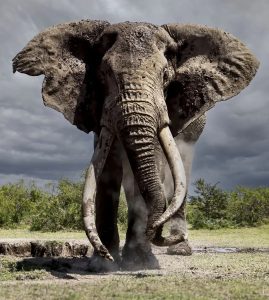
Earlier this week, news spread of the death of Craig, believed to be one of Africa’s largest super tuskers, elephants whose tusks exceed 100 pounds each. Craig died at age 54, with his death linked to severe molar wear, a well-documented natural process in elephants.
Elephants can live into their 60s and 70s, but they cannot outlive their teeth. They rely on a finite number of molars that move forward through the jaw over a lifetime, gradually pushing out worn teeth rather than erupting vertically, as in most mammals. Over their lives, elephants cycle through six sets of molars. By their 50s and 60s, elephants are relying on their final set, which may already be significantly worn and must last for the remainder of their lives.
As these final teeth wear down, chewing becomes less effective. Elephants may no longer be able to grind enough food to maintain weight and strength, and often spend more time near water, where softer vegetation is easier to eat.
For a super tusker like Craig, dying this way reflects a life shaped by survival. His death stands as evidence that sustained protection and anti-poaching efforts can allow elephants to live long enough to age naturally.
Photo: Big Craig of Amboseli. A natural end to a protected life.