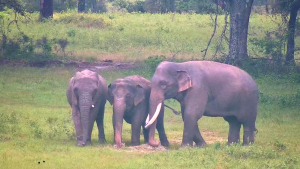
The word “elephant” traces to the Greek word “elephas,” which originally referred to ivory and only later to the animal itself. Greeks knew elephant tusks through trade for centuries before Greek armies encountered living elephants on Asian battlefields.
“Pachyderm” came later. In 1796, Georges Cuvier grouped elephants with rhinos, hippos, tapirs, pigs, and even horses as non-ruminant hoofed mammals. That classification is now obsolete, but the word “pachyderm” is still used informally today, most often to refer to elephants. Today, elephants belong to the order Proboscidea. They are the only living proboscideans; extinct members of the order include mammoths, mastodons, and many other species.
“Jumbo” added a modern twist. The famous African elephant’s name became associated with elephants and anything oversized after his circus fame and death in 1885. His name’s origin is uncertain, but elephant researcher Jeheskel Shoshani pointed to one possible source: “onjamba,” an Angolan word for elephant.
Long before Europeans labeled elephants, people living in the elephants’ native range had their own names. In Asia: “haathi” in Hindi, “chang” in Thai, and “gaja” in Sanskrit. In Africa: “tembo” in Swahili and “indlovu” in Zulu.
Familiar words tell a history of trade, science, and spectacle. But names from Asia and Africa remind us that elephants were known, named, and understood long before the Western world tried to define them.
Photo: Mundi, Tarra, and Bo