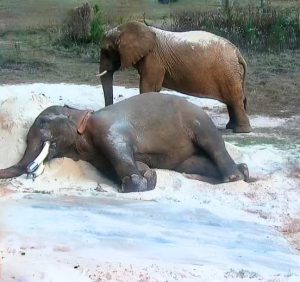
In the wild, elephants sleep just two to three hours a day in short intervals and can go nearly two days without sleep if needed. Most captive animals tend to sleep more than wild animals, with adult elephants being no exception, sleeping four to six hours a day.
Elephants sleep both standing (catnapping) and lying down (recumbent). Rapid eye movement (REM) sleep, tied to dreaming and memory consolidation in other mammals, requires atonia, a near-total loss of muscle tone. A standing elephant cannot lose muscle tone without collapsing, so REM occurs only while lying down.
Wild elephants lie down just once every three or four days, reserving the position for moments they judge safe from threats or other disturbance, since lying down leaves them slower to rise and flee. Captive elephants may or may not have more opportunity to lie down, depending on the facility and conditions, and some restrained by tight chains may be unable to lie down at all.
Scientists usually confirm REM through brain-wave recordings, though even then, whether an animal dreams remains a guess, since only humans can describe their dreams. Elephant skulls are too large for that method, so researchers instead use trunk stillness and lying-down posture to infer REM, leaving elephant dreaming a guess stacked on another guess.
Elephants are known for exceptional long-term memory despite entering REM so infrequently. Some researchers now suspect elephants simply don’t need frequent REM the way other mammals do, which would mean the long-standing assumption that REM is essential for memory consolidation may not hold true across all species.
Photo: Bo and Mundi taking an afternoon nap in a pile of sand