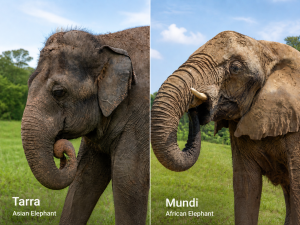
Elephants have sparse hair distributed unevenly across their bodies, with the most noticeable concentrations on the trunk, tail, and top of the head.
For most mammals, hair insulates against cold. In elephants, sparse hair may have the opposite effect. Their widely spaced, pin-shaped hairs can help release heat from the skin, acting almost like tiny cooling fins in the warm climates of Asia and Africa.
Elephant hair also has practical uses. Long eyelashes help protect the eyes, while coarse bristles around the trunk openings can help filter dust and debris. Sensitive hairs on the trunk also contribute to touch, helping elephants gather information as they explore food, objects, and their surroundings.
Tail hairs are thick and coarse, growing along the edges and tip of the tail, where they help swat away flies and other insects.
Hair varies between individuals and species. Asian elephants are generally hairier than African elephants, and calves have more hair than adults. Baby Asian elephants often have the most visible hair, typically dark reddish-brown.
Photo: A closer look at elephant hair, Tarra’s is easier to spot, while Mundi’s is more subtle.