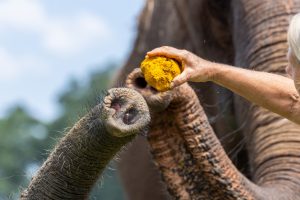
Animals use many sensory systems to navigate their world, find food, and detect danger, and in many mammals, whiskers act as touch sensors, helping them monitor their surroundings. Elephants have whiskers too, but a recent study suggests their trunk whiskers may be unlike those of any other animal.
Elephant trunks are lined with roughly 1,000 specialized whiskers that enhance the trunk’s sensitivity. Published in Science, the study focused on Asian elephant trunk whiskers and found that, unlike the actively moving whiskers of rats, mice, and many other mammals, they do not sweep back and forth on their own. Instead, the trunk moves, bringing the whiskers into contact with objects.
Researchers also found that elephant trunk whiskers are not uniform. They shift from a thick, stiff, more porous base to a thinner, softer, denser tip, in contrast to most other animal whiskers. This structure is similar to cat whiskers, but unlike cat whiskers on the face, elephant whiskers are part of a much larger touch system: a powerful, boneless trunk that can pick up small pieces of food, pull branches, explore the ground, and exchange social touch.
Together, changes in shape, structure, and stiffness may help amplify touch signals and support the trunk’s delicate handling of objects, while helping the whiskers withstand the wear and tear of life on a trunk.
Study: https://www.science.org/doi/10.1126/science.adx8981
Photo: Tarra and Mundi show off their trunk whiskers