For decades, biologists puzzled over why larger, longer-lived animals did not appear to develop more cancer than smaller, shorter-lived ones, despite having far more cells and more opportunities for cancer-causing changes. This gap became known as Peto’s paradox.
A peer-reviewed 2025 study analyzed cancer records from 263 species of mammals, birds, reptiles, and amphibians. Researchers found that larger species did, in fact, have a higher prevalence of benign and malignant tumors, evidence that runs counter to the original paradox.
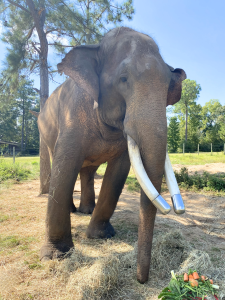
Elephants remain exceptional within this pattern. Species that evolved large body sizes over relatively short evolutionary timescales, elephants among them, developed stronger control over abnormal cell growth along the way. Although elephants are roughly ten times larger than tigers, the two carry about the same cancer risk.
Elephants are not immune to cancer, but they experience far less cancer than their enormous bodies would predict. Their defenses include roughly twenty copies of the tumor suppressor gene TP53, compared to a single copy in humans, along with other mechanisms that detect DNA damage and prevent compromised cells from multiplying.
Studying these natural defenses could help scientists identify new approaches to preventing and treating cancer in humans.
Photo: At 12,000 pounds, Bo embodies elephants’ remarkable cancer resistance.