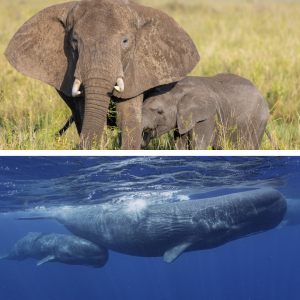
Elephants and sperm whales are a striking example of convergent evolution, a process seen throughout nature in which unrelated species independently evolve similar traits. Researchers argue that, in many ways, elephants and sperm whales have more in common with each other than either does with closely related or ecologically similar species. In a 1996 article, they called these parallels “a colossal convergence,” referring to their size and many shared traits.
Elephants are the largest land mammals; sperm whales are the largest toothed whales. Sperm whales possess the largest brains of any animal; elephants have the largest among land mammals. Both reach sexual maturity late, live 60 years or more, produce few offspring, and provide high levels of parental care. Females generally bear single calves several years apart, and reproductive rates decline with age.
Both form stable, multigenerational groups of females and offspring, with females generally remaining in their birth groups for life. Members coordinate activities and bond through physical contact. Other females help protect and care for calves. Young males leave their birth groups and range widely. Once considered largely solitary, adult males of both species form lasting associations.
Both communicate across long distances using sound. Elephants produce low-frequency rumbles, some below human hearing. Sperm whales exchange patterned sequences of clicks called codas, often compared to Morse code.
Humans heavily targeted elephants for ivory and sperm whales primarily for oil. Slow maturation and low reproductive rates have hindered population recovery. The 1996 authors argued that, apart from humans, no other large mammals had occupied and thrived across such broad geographic ranges, except where hunting decimated their populations.
Photo: A wild African elephant mother and calf and a sperm whale mother and calf