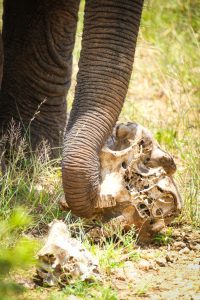
Elephant thanatology is part of comparative thanatology, the scientific study of how nonhuman animals respond to death. Within this field, a few socially complex and cognitively advanced groups stand out for the range and duration of their responses to their dead: primates, cetaceans such as whales and dolphins, and proboscideans, the order that includes elephants.
Decades of field observations show elephants visiting and revisiting mortality sites across stages of decomposition, from fresh carcasses to scattered, sun-bleached bones. They sniff, touch, and linger, sometimes with heightened social interactions. These responses occur across varying degrees of familiarity with the deceased.
Unlike most earlier research, which focused on fresh female or calf remains, a 2026 study documented repeated visits to an adult bull’s bones in southern Kenya nearly three years after his death. Most visits involved solitary males or bachelor groups, showing that male elephants also investigate the long-dead remains of another male.
Researchers have proposed several explanations for elephants’ interest in the remains of their own species, including memory of the site, familiarity with the deceased, lingering scent cues, and chance encounters near well-traveled routes. These visits may also help elephants update information within their fission-fusion society, in which social groups separate and reunite. Further study is needed to determine which factors drive this behavior and what it may reveal about how elephants process death.
Photo: A wild African elephant investigates the weathered skull of another.