Adult bull elephants live apart from female herds for most of their lives, either alone or in loose bachelor groups. Unlike many animals that remain near potential mates, bulls must locate receptive females across large landscapes.
Bulls seek mating opportunities throughout adulthood, though musth, a period of elevated testosterone and intensified reproductive behavior, increases both motivation and competitive success. As a bull ranges, he moves through areas used by female family groups, encountering the same families repeatedly across seasons and likely building familiarity with their travel patterns.
When seeking a mate, a bull may travel to known family ranges or be drawn in by estrous calls, low-frequency rumbles from receptive females that carry over long distances. On approach, he assesses each female for reproductive readiness, collecting urine with his trunk and placing it on the Jacobson’s organ in the roof of his mouth.
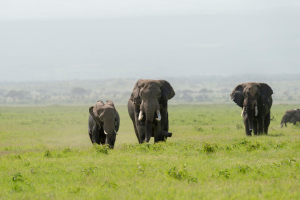
Once he locates a fertile female, the challenge is maintaining access. He stays close, follows her movements, and guards her from rivals. Older males, especially those in musth, usually dominate younger challengers. If successful, he mates with her and remains with her in a brief consortship, or temporary mating association, that may last a few days before moving on.
Photo: Bull alongside female, maintaining position consistent with mate guarding, Amboseli National Park, Kenya, Africa.