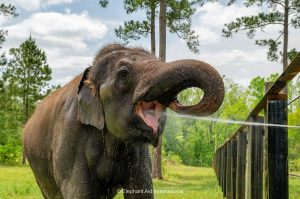
Elephants have a massive tongue that can weigh up to 26 pounds. Like other mammalian tongues, it is a muscular hydrostat, moving without internal bones or joints. An octopus’s arm and the elephant’s trunk use the same principle. Fibers running in different directions reshape it, allowing it to fold, shift, and maneuver inside the mouth.
Unlike humans or dogs, an elephant can only stick the tip of their tongue out past their lips. Connective tissue broadly anchors the underside of their tongue to the floor of the mouth, leaving little free movement at the front. At the rear, the hyoid apparatus provides attachment points for muscles that support and move the tongue and larynx.
Because the elephant’s trunk is the primary tool for gathering food, stripping branches, and drawing up water, the tongue does not need to extend outside the mouth. Elephants use their trunks to place vegetation inside their mouths, where the tongue takes over. It folds in the center and pulls the food to the back of the mouth, where four large, ridged molars grind coarse bark, roots, and fibrous grasses.
The tongue also provides taste and tactile information. Well-developed oral glands produce saliva that moistens vegetation for swallowing. Although African and Asian elephants have differently shaped trunk tips, their tongues are essentially alike.
Photo: Tarra’s tongue is on display as she enjoys a drink from the hose