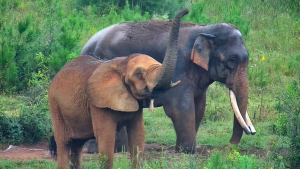
Elephants are the largest living land mammals, but their evolutionary history began with much smaller animals. Eritherium, an early relative from Africa about 60 million years ago, is estimated to have weighed 10 pounds. Many lineages later evolved larger bodies, consistent with Cope’s rule, an evolutionary tendency toward increasing size. Some extinct species exceeded the size of today’s elephants.
In mammals, large bodies can protect against predators and generally require less energy per pound than smaller ones. This helps elephants sustain themselves on fibrous, relatively low-nutrient foods such as grasses, leaves, and bark, although they consume enormous quantities.
Elephant evolution has not followed a single path toward larger bodies. Some large-bodied lineages evolved into dwarf species on islands such as Sicily, where limited resources may have favored smaller descendants. Today, Bornean elephants are smaller than other Asian elephants, while African forest elephants are smaller than their savanna relatives. Namibia’s desert elephants can look leaner, likely because they eat less. Larger bodies require more food, so bigger isn’t always an advantage.
Photo: Mundi and Bo, side by side in different sizes.