Three elephant species are recognized: African savanna, African forest, and Asian. In March 2021, the International Union for Conservation of Nature (IUCN) first assessed the African species separately. Savanna and Asian elephants are Endangered; forest elephants are Critically Endangered.
African elephants live across 37 countries south of the Sahara. Savanna elephants inhabit grasslands, woodlands, and other habitats; forest elephants live mainly in the tropical forests of Central and West Africa.
Africa had an estimated 1.3 million elephants in 1979. IUCN’s 2016 population report estimated approximately 415,000 across both species in surveyed areas, with additional elephants in areas lacking systematic surveys.
Asian elephants live in 13 countries across South and Southeast Asia, including southern China. Their wild population is roughly estimated at 45,000–50,000. IUCN’s 2020 assessment estimated a decline of at least half since 1945.
Ivory poaching, habitat loss, and conflict with people threaten African elephants. In Asia, habitat loss and fragmentation are the greatest threats, dividing populations and blocking travel routes. Capture for captivity, poaching, train collisions, and electrocution also threaten Asian elephants.
Conservation efforts have helped some elephant populations stabilize or grow—a reminder that protection can make a difference.
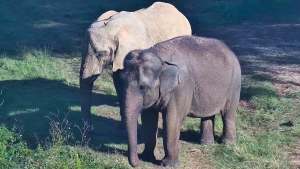
Photo: Mundi, an African savanna elephant, and Tarra, an Asian elephant, grazing at ERNA