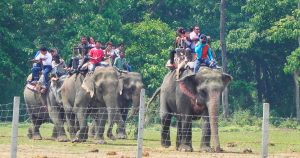
For years, groups and individuals have been working to help improve the well-being of captive-held elephants in Nepal.
When I started my decades-long effort, the learning curve was sharp and complicated. Immersing myself in the culture was essential to understanding how things worked, which helped me devise ways to improve elephants’ lives.
The complexity of this culture, which enslaved elephants and their mahouts, was foreign to me. But like in other countries, politics and profit shaped the problem, and tourism fed it.
I found that, contrary to popular belief, the mahouts were not the endemic problem; the problem lay with the owners and their motivations for owning elephants. The mahouts were an avenue for owners to profit, placing the blame for the elephants’ deprived lives on them. A closer look exposed that the mahouts, in most cases, were just poorly paid, exploited people whose lives were chained to those of the elephants they cared for. The fact that mahouts are the secondary problem does not relieve them of responsibility for their actions; it explains their actions, which enabled me to identify ways to relieve the suffering of both man and elephant.
A valuable lesson learned after years of work in Nepal was that the best idea is worthless unless it is embraced by the powers that be: the owners and the government. Without a buy-in by those in power, no project is sustainable. This demonstrated another problem that I had not anticipated. What might look like a buy-in to a project can evaporate with the appointment of a new chief warden, a new government veterinarian, or a politician.
Years ago, I sat in the office of Pro Public in Kathmandu, brainstorming ways to improve elephant welfare. There was deep interest, but I held little hope for change. When I learned about the writ petition filed by Pro Public to end cruelty against elephants, I was hopeful but reticent.
Then the news was announced: the Supreme Court of Nepal issued a directive in response to the writ petition, resulting in the possibility of real change for elephants.
In a landmark full-text verdict, the Court declared traditional elephant safaris incompatible with animal welfare, ruling that elephants are highly sensitive, intelligent beings.
The court’s decision establishes critical directives to protect elephants:
Ban on Traditional Safaris: The Court ruled that an elephant’s skeletal structure is not designed to carry human weight. It ordered the government to phase out traditional riding and transition to ethical, environmentally friendly tourism.
Safe Observation Models: Endorsing global animal welfare practices, the Court directed authorities to adopt the “Elephant-Friendly Walk,” “Bush Walk,” and “Observation-Only” models where tourists view elephants from a safe distance.
End to Chaining: The ruling mandates the implementation of chain-free management and requires the government to provide sufficient open space and natural diets.
Rehabilitation Centers: The government has been ordered to establish retirement and rehabilitation centers specifically for elderly and disabled elephants.
Change is on the horizon in Nepal. It may happen slowly, but I am encouraged to see this important step taken by the Supreme Court. Elephants and their mahouts will benefit, and ultimately, the public might be privy to seeing elephants in a natural environment, free to be their authentic selves.
I am eternally grateful to Pro Public for their dedication, expertise, and altruism. They and the Supreme Court deserve all the credit for this game-changing decree.